1 day (24 hrs) UNIVERSITY Membership for $1 USD
The International XPS Spectra-Base of
Monochromatic XPS Reference Spectra ($1 USD)
$1 for 24 hour trial
You must Register before you can Purchase any Membership
and be sure to add your University name of Company name to the Billing Address
Check your E-mail for Delivery of your Temporary Password
After Purchase is completed, the name and details about your new Membership are shown in My Account (your account)
To add this item for purchase, then go to the “Add to Cart” button at the bottom of this page.
or
select “Proceed to Checkout“
or
return to “Shopping Store”
To learn more about this product, then continue to scroll down this page.
Overview
Each page provides XPS spectra from a series of materials: pure element, native oxide, most common pure oxide, and other chemical compounds that may include hydroxide, oxy-hydroxide, carbonate, bi-carbonate, sulfide, sulfate, nitride, nitrate, phosphide, phosphate, selenide, telluride. Most of the oxides are single crystals or natural crystals freshly cleaved to expose bulk. Semiconductor wafers and crystals have been cleaved to expose bulk. There are time-based Profiles, Flood Gun tests, and Auger spectra. To add a bit of color, there are two sets of photos from crystals that include the element being displayed. A total of six (6) different BE tables from various sources are included.
The Spectra-Base currently (Jan 2025) has:
-
-
- >500 survey spectra,
- >2,500 chemical state spectra,
- >2,500 peak-fits of chemical state spectra,
- >600 overlays of chemical state spectra,
- >400 side-by-side comparisons of chemical state spectra.
- >150 time study Montage plots showing UHV gas capture by freshly ion etched metals,
- >150 overlays showing flood gun effects on native oxides
- >200 photos of minerals containing element of interest
- >90 tables of key information listing peak overlaps, spin-orbit terms, BEs, Scofield cross-sections and IMFP of pure element
- >500 tables of BEs (from 6 different sources)
Components on each Page:
Basic Information Section (spectra and BE tables)
- Three (3) links to: (a) Periodic Table, (b) XPS Database of Polymers, and (c) Six (6) BE Tables
- ….Page Index (not yet active).
- Chemical State Spectra (raw and peak-fit with details)
- Survey Spectra (fully labelled, pure element, native oxide, pure oxide, other chemical states)
- Carbon (1s) and O (1s) spectra (or F (1s), S (2p), N (1s), P (2p), Cl (2p), Br (3d), I (4d), Se (3d), Te (4d) etc.)
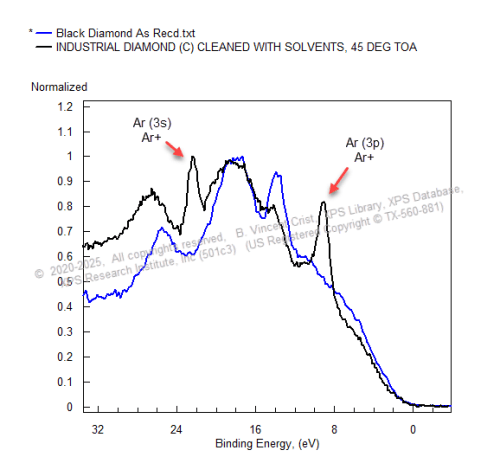
- Valence Band Spectra
- Spectra of Auger Signals
- Plasmon Spectra
- Table of Overlaps, BEs, Scofield cross-sections, and IMFP
- Links to home page – Periodic Table and Six (6) BE Tables
- Artefacts of ion etching
- Side-by-side spectra for comparisons (native oxide versus element versus pure oxide…)
- Overlays of related spectra (e.g. metal, native oxide, pure oxide, sulfide, BE shifts, peak-shape differences)
- Six (6) Tables of Chemical State BEs from different websites (BEs are from smallest to largest)
- The NIST table is quite long and organized by BE value (smallest to largest)
- Histograms of pure element BEs, pure oxide BEs and others from NIST SRD-20 database of BEs
- Periodic Table showing results of Statistical Analysis of BEs in NIST SRD-20 database of BEs
Advanced Information Section (advanced spectra & research studies)
- Comparison of Element, Pure Oxide, and Fluoride of the Element (showing extreme range of BEs)
- Detailed set of spectra from common pure oxide
- Display of spectra having Shake-up
- Display of spectra having Multiplet Splitting
- Flood gun effect on Native Oxide of Element (flood gun OFF versus ON and Floating: C (1s) O (1s) and Metal Signal)
- XPS Study of UHV Gas Captured by Freshly Ion Etched Element – in main analysis chamber – overnight run – C (1s), O (1s) and metal signal
- AES (Auger) Study of UHV Gas Captured by Freshly Ion Etched Element – in main analysis chamber – overnight run – C (1s), O (1s) and metal signal
- Chemical State Spectra from High Energy Resolution Auger instrument having CHA (HSA) electron analyzer
Tables of XPS Facts, Guidance & Information
- Basic information about element
- Information useful for peak-fitting main element signal
- General guidance for peak-fitting
- Commonplace Contaminants
- Data collection guidance
- Data collection settings for each element
- Effects of argon ion etching
- Gas phase spectra of related species if available